 DPP Knowledge Base
Glossary: Digital Product Passport terms
The terms that come up again and again around Digital Product Passports – from access class to working plan – each explained in a few sentences, with a link to the article that goes deeper.
In short
- Short, plain explanations of the terms used in this Knowledge Base, in alphabetical order.
- Where a law or standard defines a term, the explanation paraphrases it; the binding wording is in the source.
- Each entry links to the article that explains the topic in full.
A
- Access class
- A label that says who may read an attribute of a passport. The DPP Service uses three ordered classes: public, legitimate interest and authority. See Role-based access.
- Access grant
- A signed statement that lets one reader, identified by its DID, read certain passports in certain access classes. Valid for at most a year and revocable at any time.
- Access log
- The record the DPP Service keeps of every read of controlled data, every refused attempt, every grant and every revocation – never the content itself.
- Annex ZA
- The annex of a harmonised standard that lists which requirements of the regulation the standard covers – and so how far the presumption of conformity reaches.
B
- Back-up copy
- A copy of a passport kept by a second, independent DPP service provider, so that the passport survives if the main one fails. The ESPR asks for it; EN 18221 describes how it works. See Who keeps the passport?.
- Battery passport
- The passport required by the Battery Regulation (EU) 2023/1542 from 18 February 2027 for electric-vehicle batteries, batteries for light means of transport and industrial batteries above 2 kWh. See Battery passport.
C
- CIRPASS-2
- The EU project that prepares the Digital Product Passport for use at scale. Its reference architecture describes the roles and building blocks of a complete DPP system. See CIRPASS-2 reference architecture.
- Content binding
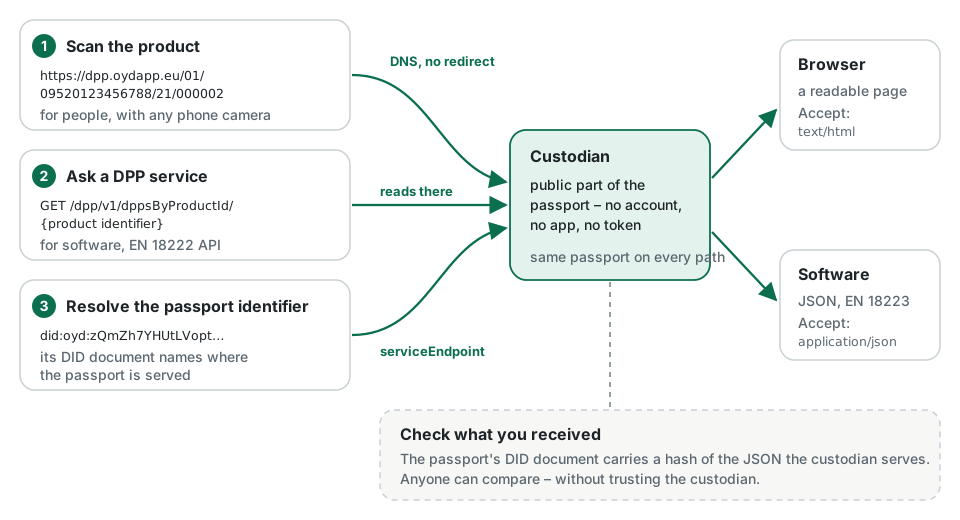
- Recording a hash of a passport’s content in the signed log of its DPP identifier, so that anyone can check that what they receive is what the operator published. See Public availability.
- Controlled part
- The part of a passport with every attribute that is not public. It is handed out only to readers whose access class allows it. Its counterpart is the public part.
- Criteria catalogue
- The open repository dpp-criteria, which turns legal and standard requirements into checkable criteria. See The DPP criteria catalogue.
- Custodian
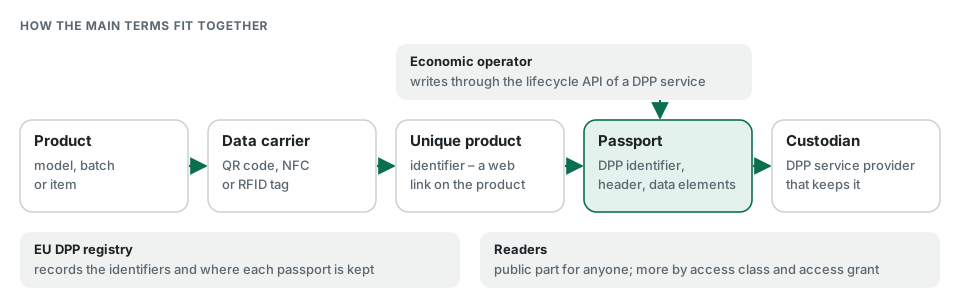
- The party that keeps a passport and serves its public part on the link on the product, under a mandate from the economic operator – a DPP service provider, or the operator itself. See Who keeps the passport?.
D
- Data carrier
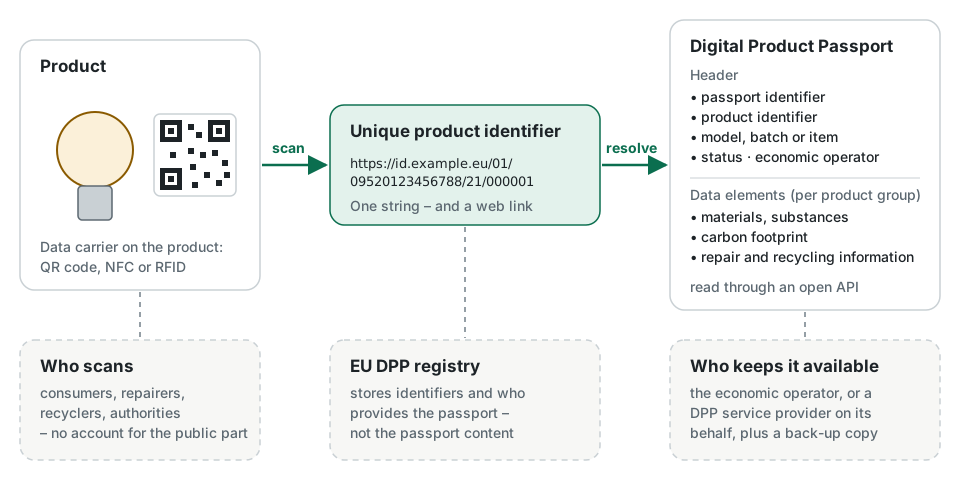
- What sits on the product, its packaging or its documents and holds the unique product identifier: a QR code, an NFC chip or an RFID tag. Covered by EN 18220.
- Data element
- One piece of passport content below the header, such as the carbon footprint or a spare-part list. Which data elements a passport needs is decided per product group.
- Delegated act
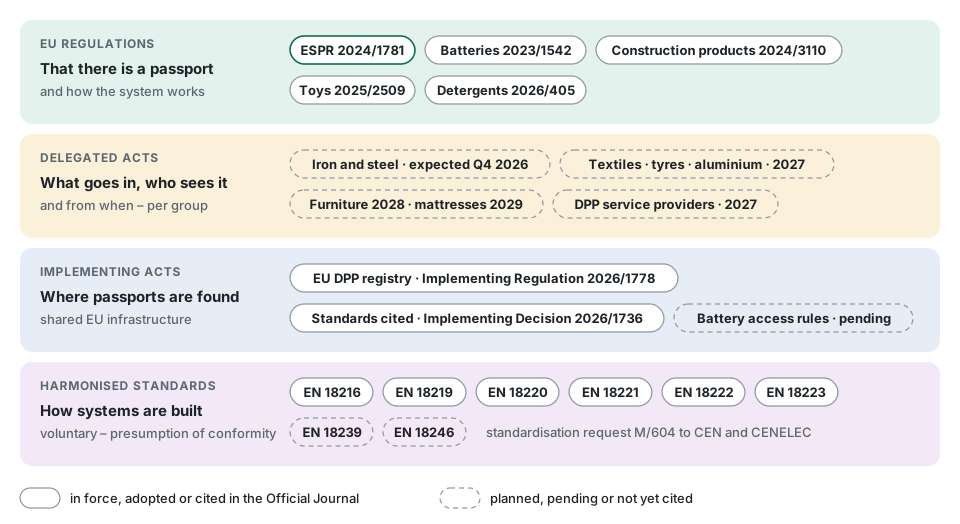
- An act of the Commission that supplements a regulation. Under the ESPR, one delegated act per product group decides what its passport contains, who may see it and from when – at the earliest 18 months after the act enters into force. See the roadmap.
- DID (decentralised identifier)
- An identifier, standardised by the W3C, that resolves to a document controlled by its holder. Here,
did:oydis used for passport identifiers and for the identities of operators and readers. - Digital Product Passport (DPP)
- A set of data about one product – model, batch or item – that can be reached electronically through a data carrier on the product. See What is a Digital Product Passport?
- DPP identifier
- The identifier of the passport itself, as opposed to the identifier of the product. Here it is a
did:oyd, whose signed log records where the passport is kept and a hash of its content. - DPP service
- A system that offers the lifecycle API for passports. The DPP Service of OwnYourData is one open implementation.
- DPP service provider
- A company that keeps or serves passports on behalf of an economic operator. The Commission plans rules for such providers, including certification, for 2027.
E
- Economic operator
- The company that places a product on the EU market and is responsible for its passport. It can keep the passport itself or have a DPP service provider do it.
- EN 18216 to EN 18246
- The eight European standards for the passport system, written by CEN and CENELEC in their joint technical committee JTC 24. See Laws and standards.
- ESPR
- The Ecodesign for Sustainable Products Regulation, (EU) 2024/1781. It sets the framework for passports for most product groups.
- EU DPP registry
- The Commission’s registry, live since 20 July 2026. It records unique identifiers and where each passport is kept – not the passport content.
G
- Granularity
- Whether a passport describes a product model, a batch or a single item. The delegated act for a product group decides which.
- GS1 Digital Link
- A web address that carries GS1 keys, such as the product code after
/01/and the serial number after/21/. Often used as the unique product identifier. See QR code, GS1 Digital Link and unique identifiers.
H
- Harmonised standard
- A European standard cited in the Official Journal under a regulation. Following it gives a presumption of conformity for the requirements it covers.
I
- Implementing act
- An act of the Commission that sets uniform conditions for applying a regulation – for example the rules for the EU registry, or the citation of the standards.
L
- Legitimate interest
- Under the Battery Regulation, the group of readers – such as repairers, second-life operators and recyclers – who may see more of a passport than the public. An implementing act is to define it.
- Lifecycle API
- The interface defined in EN 18222 to create, read, update and end passports, and to read earlier versions.
M
- Mandate
- A signed statement by which an economic operator lets a custodian keep one passport at one storage place for a set time.
- Market surveillance authority
- The national authority that checks whether products on the market comply with EU law. It gets access to the parts of a passport reserved for authorities.
P
- Presumption of conformity
- The legal effect of following a harmonised standard: the product or system is presumed to meet the requirements the standard covers, unless shown otherwise.
- Public part
- The part of a passport that anyone can read through the link on the product, without an account. It carries a salted digest of the controlled part.
S
- SOyA
- The Semantic Overlay Architecture: a way to describe data models with a base structure and overlays for labels, validation and transformation. The DPP Manager uses it for product types.
U
- Unique product identifier (UPI)
- A string that identifies a product and at the same time works as a web link to its passport. Covered by EN 18219. See QR code, GS1 Digital Link and unique identifiers.
W
- Working plan
- The Commission’s ESPR and Energy Labelling Working Plan 2025–2030, which sets the order in which product groups get delegated acts.
Missing a term?
The Knowledge Base is open. Suggest a term or a better explanation as an issue or pull request.
Further reading
- Regulation (EU) 2024/1781 (ESPR), Article 2the legal definitions behind many of these terms
Related articles
What is a Digital Product Passport?
A digital record that travels with a product, reachable by scanning the product itself. What the EU requires, what a passport contains, who reads it and when it becomes mandatory.
Laws and standards behind the Digital Product Passport
Which EU regulations require passports, what delegated and implementing acts add, and which eight European standards say how passport systems are built – with the state of each as of October 2026.
Public availability: from QR code to passport
How anyone gets from the code on a product to its passport – without an account or an app – why the link on the product never has to change, and how a reader can check that the data is genuine.