 DPP Knowledge Base
Roadmap: when Digital Product Passports become mandatory
Batteries come first, then one product group after another. Which groups are planned when, what has been decided so far, and how a passport obligation comes about – as of October 2026.
In short
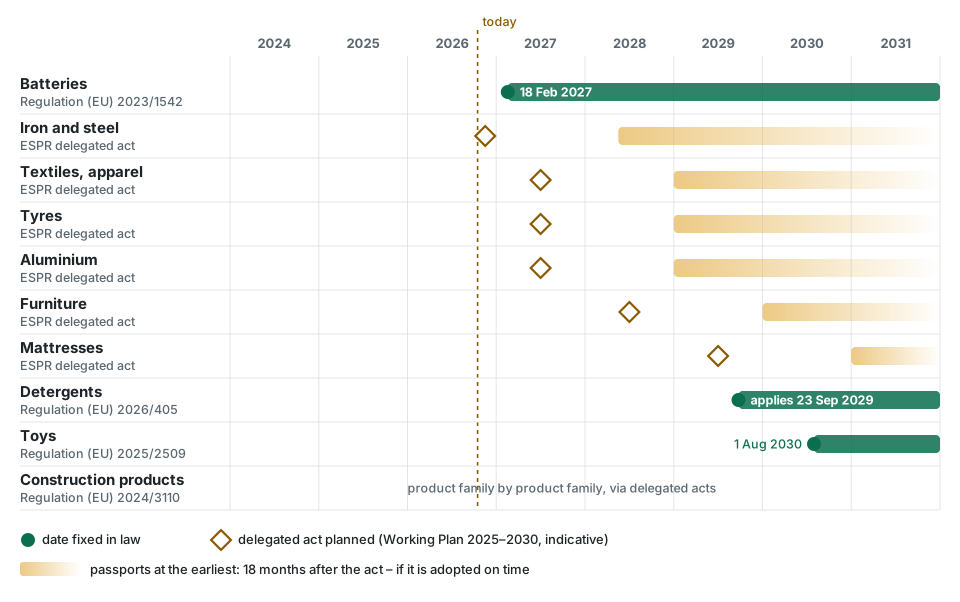
- Batteries are first: electric-vehicle, light-means-of-transport and larger industrial batteries need a passport from 18 February 2027.
- Under the Ecodesign Regulation (ESPR), each product group gets its own delegated act. Iron and steel is next; the Commission expects to adopt it in Q4 2026. Textiles, tyres and aluminium are planned for 2027, furniture for 2028, mattresses for 2029.
- A delegated act applies at the earliest 18 months after it enters into force. Passports for these groups therefore start in 2028 at the earliest.
- Toys, detergents and construction products get passports under their own regulations.
- As of mid-October 2026, no ESPR delegated act with passport requirements has been adopted.
How a passport becomes mandatory
The ESPR, in force since July 2024, creates the framework: it says that products will have passports and how the system works. It does not say which products need one or what goes into it. That is decided product group by product group in delegated acts.
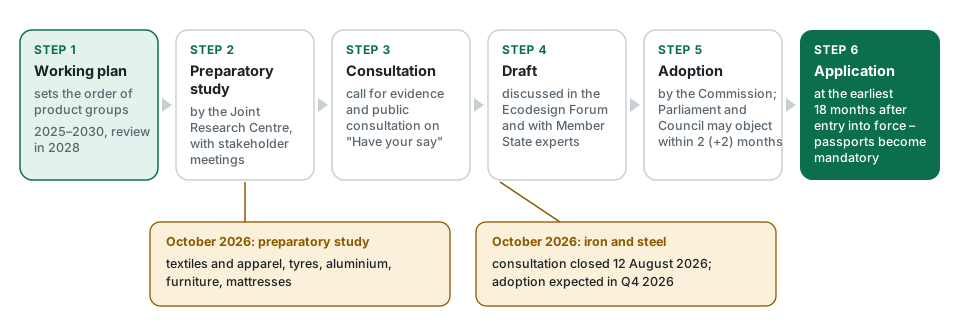
Two numbers in the regulation set the pace:
- Parliament and Council have two months, extendable by two, to object before a delegated act enters into force.
- Its date of application may not be earlier than 18 months after entry into force, except in duly justified cases. Every product group therefore gets at least a year and a half of lead time.
The order comes from the Commission’s Working Plan 2025–2030, adopted on 16 April 2025. Its dates are indicative and will be reviewed in 2028.
The roadmap at a glance
| Product group | Legal basis | Date | Status in October 2026 |
|---|---|---|---|
| Batteries (EV, light means of transport, industrial > 2 kWh) | Regulation (EU) 2023/1542 | passport from 18 Feb 2027 | fixed; rules on legitimate-interest access still pending |
| Iron and steel | ESPR delegated act | planned 2026 | consultation closed 12 Aug 2026; adoption expected Q4 2026 |
| Textiles, apparel | ESPR delegated act | planned 2027 | preparatory study |
| Tyres | ESPR delegated act | planned 2027 | preparatory study |
| Aluminium | ESPR delegated act | planned 2027 | preparatory study |
| Furniture | ESPR delegated act | planned 2028 | preparatory study |
| Mattresses | ESPR delegated act | planned 2029 | preparatory study |
| Detergents | Regulation (EU) 2026/405 | regulation applies from 23 Sep 2029 | adopted |
| Toys | Regulation (EU) 2025/2509 | applies from 1 Aug 2030 | adopted |
| Construction products | Regulation (EU) 2024/3110 | product family by product family | delegated acts in preparation |
“Planned” means the year in which the Working Plan expects the Commission to adopt the delegated act – not the year from which passports are required.
Batteries: the first passport
From 18 February 2027, every electric-vehicle battery, every battery for light means of transport such as e-bikes and e-scooters, and every industrial battery above 2 kWh placed on the EU market needs a passport. The obligation lies with whoever places the finished battery on the market. Simplification packages adopted or proposed so far leave this date unchanged.
What is still missing are the Commission’s rules on who counts as a person with a legitimate interest and what they may access. The regulation required them by 18 August 2026; that deadline passed. The public part and the part for authorities can already be built against Annex XIII of the regulation. How the access groups work in practice is described in Role-based access to passport data. What a battery passport has to contain, and what operators should do now, is the subject of Battery passport: what you need by 18 February 2027.
ESPR product groups: one after another
Iron and steel is the first ESPR product group. The Commission published a call for evidence and a public consultation in May 2026, open until 12 August 2026. The measures under consideration include information on the carbon footprint and recycled content, substances that hinder recycling, performance classes based on the carbon footprint, and a passport for all actors in the supply chain.
Textiles and apparel, tyres and aluminium are planned for 2027, furniture for 2028 and mattresses for 2029. For each, the Joint Research Centre is preparing the technical basis in a preparatory study with stakeholder meetings.
Alongside the product groups, the Working Plan foresees two horizontal measures: a repairability score, planned for 2027, and requirements on recycled content and recyclability of electrical and electronic equipment, planned for 2029.
Some products are not in this first plan. Footwear gets its own study, to be completed by the end of 2027; for chemicals, a study is to define the scope first. Both will be reassessed in the mid-term review in 2028.
Energy-related products that already have ecodesign rules – dishwashers, fridges, displays and others – get updated rules under the ESPR between 2026 and 2030. Where a product carries an energy label, the existing EPREL database may take the place of a separate passport.
Other regulations with passports
- Toys: the new Toy Safety Regulation (EU) 2025/2509 requires a passport for toys and applies from 1 August 2030.
- Detergents: the new Detergents Regulation (EU) 2026/405 introduces a passport for detergents; it applies from 23 September 2029.
- Construction products: under the Construction Products Regulation (EU) 2024/3110, passports follow product family by product family, through delegated acts and the standards they reference.
What this means today
The content of most passports is still open. The infrastructure is not: the EU registry has been live since 20 July 2026, and six harmonised standards for identifiers, data carriers, storage, APIs and the data model were published in 2026. A passport built on those standards today will not have to be rebuilt when your product group is due – only filled with the data its delegated act requires.
This roadmap reflects the state of 16 October 2026. Dates in the Working Plan are indicative, and drafts change during consultation. Check the linked sources before relying on a date.
Be ready before your product group is due
The infrastructure is settled – the registry is live and six standards are published. Our free tools let you build and check passports on that basis today.
Further reading
- ESPR and Energy Labelling Working Plan 2025–2030, COM(2025) 187the Commission's priorities and indicative dates
- Regulation (EU) 2024/1781 (ESPR)the framework, including the 18-month rule
- Ecodesign requirements for iron and steel productsthe Commission's initiative page
- Regulation (EU) 2023/1542 (batteries)Article 77 and Annex XIII on the battery passport
Related articles
What is a Digital Product Passport?
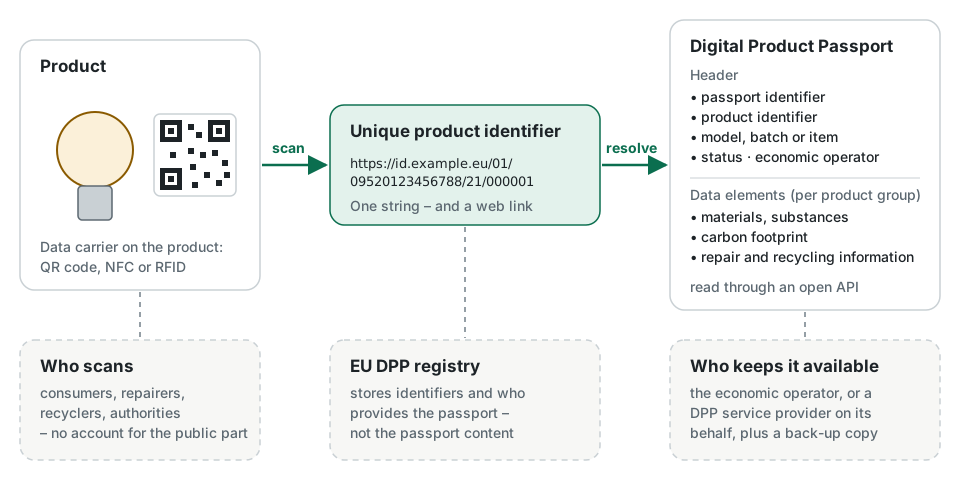
A digital record that travels with a product, reachable by scanning the product itself. What the EU requires, what a passport contains, who reads it and when it becomes mandatory.
Role-based access to passport data
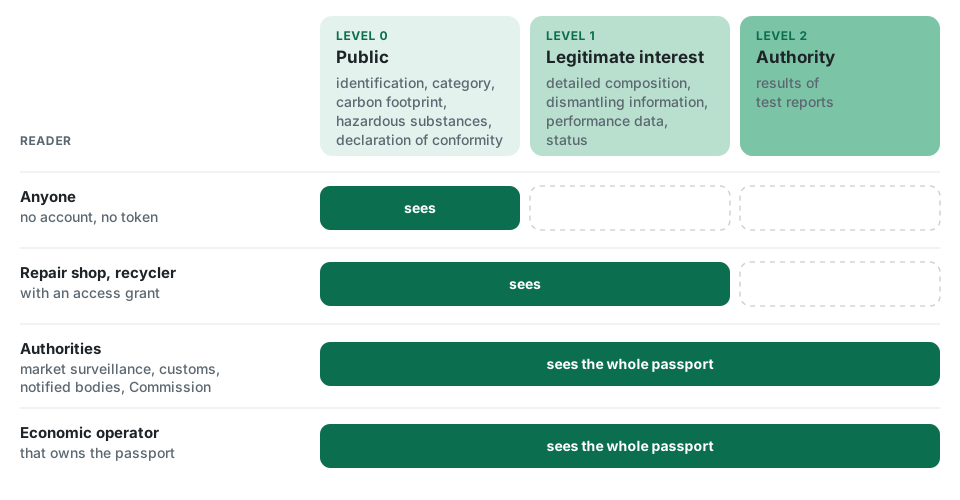
Not every field of a passport is for everyone. How the DPP Service classifies passport data, who may read what, how access is granted and revoked, and how every access is logged.